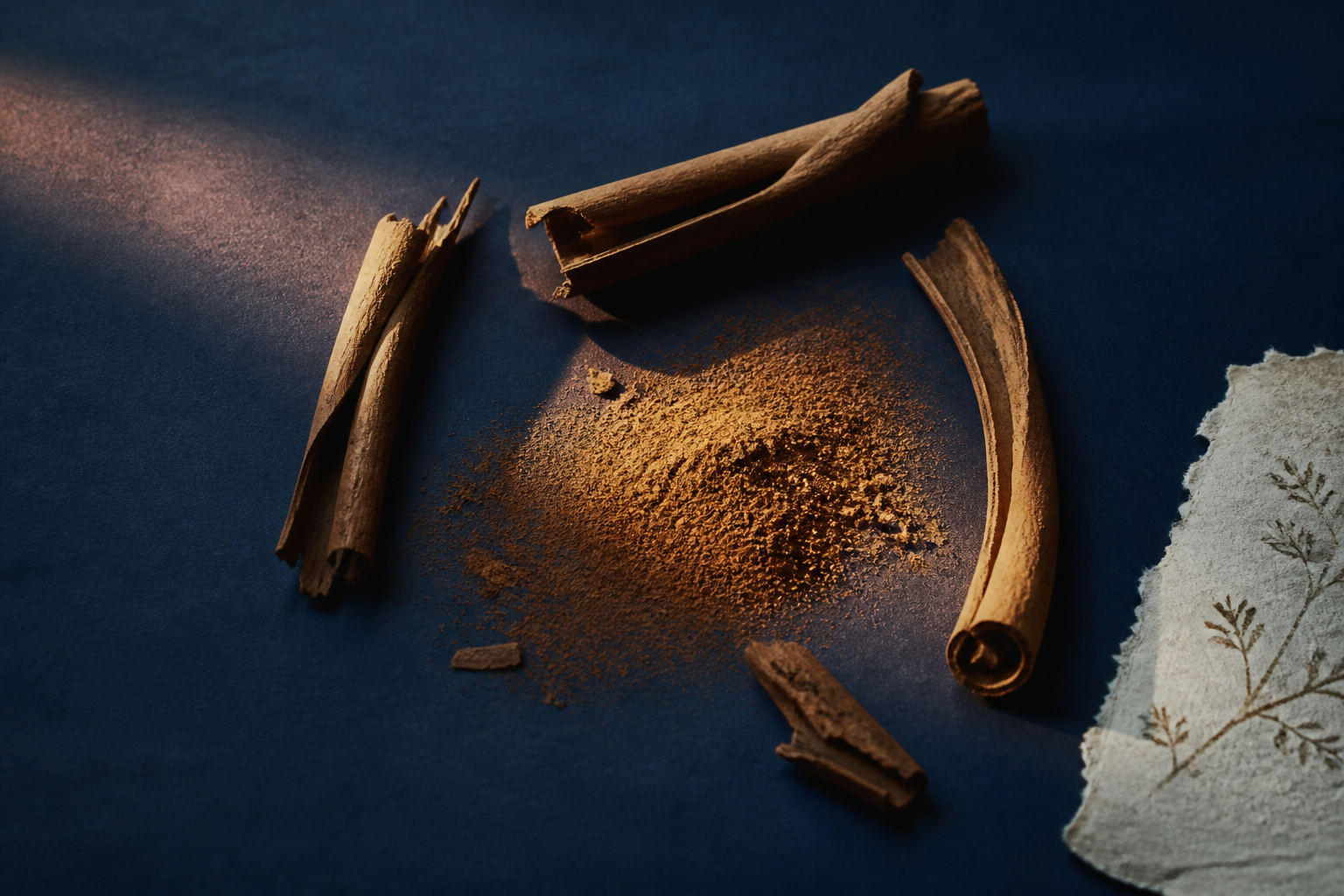
Choose the right version
- Want slow extraction in a drink, braise, or syrup? Choose whole quills.
- Want even distribution in batter, rubs, or oatmeal? Choose ground cinnamon.
- Want a particular flavor profile? Ask for the species or origin instead of assuming every cinnamon tastes alike.
A technique, not a fixed rule
Use these as a first, adjustable pass. Leaf size, cut, freshness, equipment, and the person’s preferred intensity all change the useful result.
Prepare and adjust
- For an infusion: add a whole quill to hot liquid, cover, and taste before extending the steep.
- For cooking: bloom a measured amount of ground cinnamon briefly with fat or other spices, then add liquid.
- For baking: whisk ground cinnamon through dry ingredients for the most even distribution.
Beyond the cup
Cinnamon–citrus syrup
infuse a quill in a small batch of simple syrup, then strain; use with fruit, iced tea, or sparkling water.
Fruit compote
add a restrained amount of ground cinnamon to apples, pears, or stone fruit as they cook.
Savory braise
pair a whole quill with ginger, chile, citrus peel, or black tea; remove it before serving.
Substitutions and comparisons
- Ceylon and cassia are not exact substitutes: Ceylon tends lighter and more floral-citrusy; cassia tends bolder.
- Allspice can echo part of cinnamon’s warm profile, but it is a different berry spice.
- For a quill-free infusion, use a small amount of ground cinnamon and strain through a fine filter.
Context and terminology
In U.S. food guidance, “cinnamon” can include Ceylon cinnamon, Chinese cassia, and Saigon cinnamon. That is why a precise label matters when a person has a specific flavor goal.
When a health question brings someone here
Cinnamon is often searched alongside diabetes, weight, inflammation, and “wellness” claims. The first useful answer is to name the exact cinnamon and form—not to repeat a product promise.
NCCIH says research does not clearly support using cinnamon for any health condition and that supplementation evidence for diabetes or weight loss remains unclear.
Ceylon cinnamon and cassia are not interchangeable in flavor or composition. Research can be hard to interpret when the species or plant part is unspecified.
Amounts used as a spice are different from prolonged high-dose use. Cassia products can vary in coumarin; personal medicine or liver-health questions belong with a clinician or pharmacist.
Evidence and form
For cooking, choose whole bark or ground spice for the job. For health claims, use the specific evidence source and its limitations; do not turn a pantry spice into a treatment promise.
Make this guide yours
Start with the task, the desired flavor, the form you have, and anything to avoid. A digital assistant can use those same choices to help you find the useful section of the guide; the guide remains complete on its own.
Useful starting questions
- What are you making or drinking?
- What form and equipment are available?
- What flavor, caffeine, or ingredient constraints matter?
See the editorial standards for how evidence and health questions are handled.
Substitutions
- Cassia for Ceylon (and back): both are sold as cinnamon in the United States, and the FDA definition covers Ceylon, Chinese cassia and Saigon cinnamon under one heading, so the label is doing less work than you think. Swap them by weight, not by stick: cassia bark is thick and hard, Ceylon is thin and papery, and one Ceylon quill weighs a fraction of one cassia stick. Expect the swap to change the dish — cassia is bolder and a little bitter-sweet, Ceylon is lighter and more citrus-floral. In a spiced cookie or a chili nobody will complain. In a milk custard or a poached pear, the difference is the whole point.
- Whole quill → ground, for an infusion: roughly a 3-inch cassia stick for 1/2 tsp ground. Ground keeps extracting and will cloud the liquid, so strain through a paper filter or accept sediment.
- Allspice: covers part of cinnamon's warm register at the same weight, but brings clove and pepper with it. Good in a braise, wrong in a snickerdoodle.
- No true substitute: for the aromatic top note of a freshly snapped quill in hot liquid. If that is what the recipe is built on, buy the bark.
Storage
- Whole quills: two to three years of genuinely useful aroma. The oils sit in a dense bark matrix and leave slowly.
- Ground: at its best for four to six months. At a year it still reads sweet and woody but thin, and the usual response — adding more — brings dust and a faint bitterness instead of perfume.
- Container and place: glass or metal with a tight lid, in a cupboard that is not above the stove and not in window light. Heat and light cost you more than time does.
- Gone when: a snapped quill gives you nothing at the break — a live one announces itself immediately. For ground, rub a pinch between warm fingers; if you have to hunt for the smell, it is spent. Ground cinnamon that tastes of sawdust and back-of-the-throat bitterness rather than sweetness is past it.
Pairings
- Ingredients: apple, pear, stone fruit, orange and orange peel, raisin, walnut, almond, oats, honey, brown sugar, coffee, chocolate, black tea, cardamom, clove, ginger, star anise, dried chili, lamb, beef, tomato, onion, dried beans, rice.
- Dishes: oatmeal and granola, apple or pear compote, rice pudding, buns and quick breads, chai, mulled cider, café de olla, Moroccan-style tagine, chili with beans, a long beef or lamb braise, a poaching syrup for winter fruit.
- Go carefully: ground cinnamon held at a simmer for an hour turns muddy and slightly bitter. For long cooking use a whole quill and pull it out; if you only have ground, bloom it briefly in fat with the other spices or stir it in near the end.