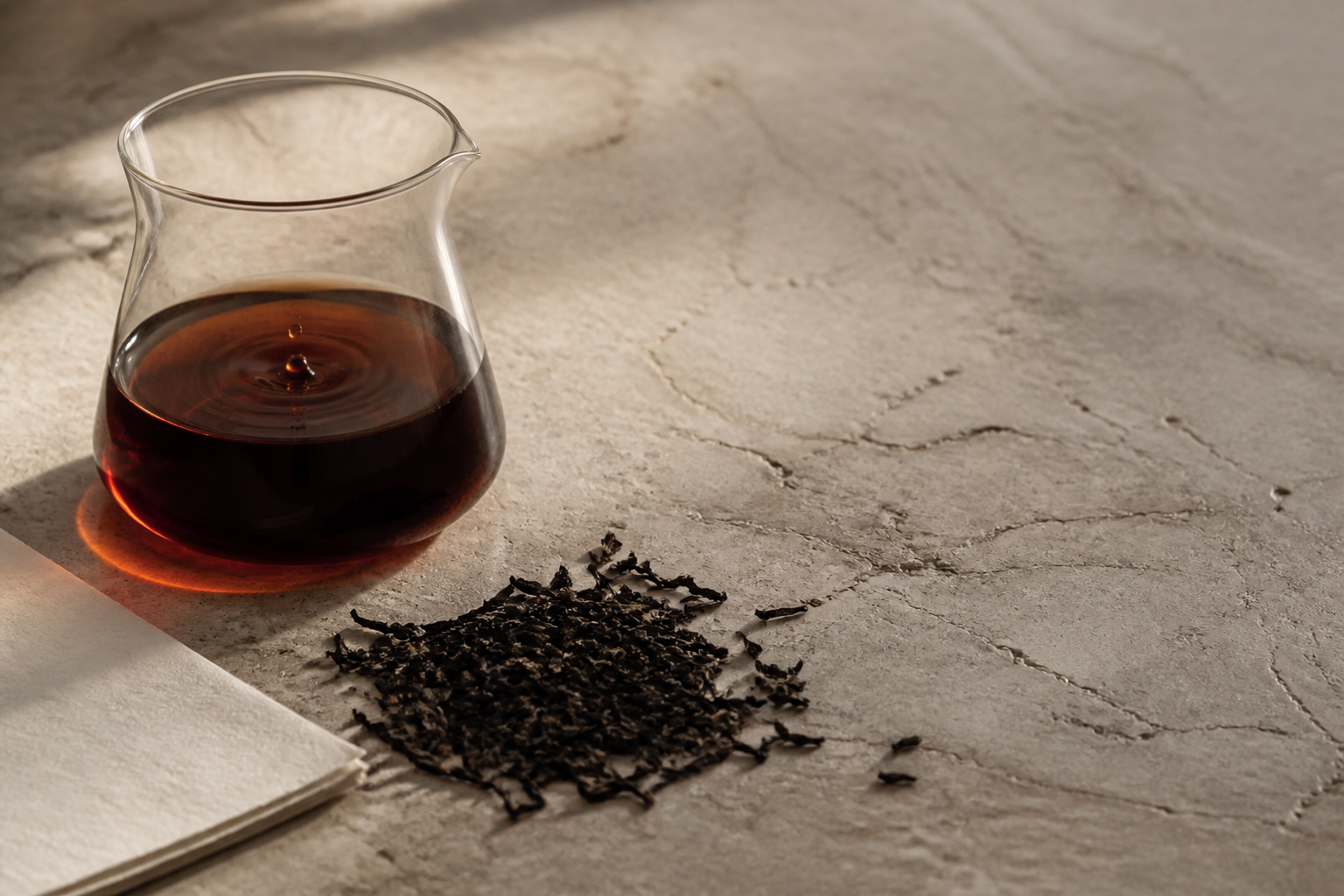
Choose the right version
- Want body for milk tea or breakfast? Look for a brisk, malty style.
- Want the tea plain? Start with a style that names its origin or flavor profile.
- Want cold tea? Brew a little stronger than usual, cool safely, and dilute over ice to taste.
A technique, not a fixed rule
Use these as a first, adjustable pass. Leaf size, cut, freshness, equipment, and the person’s preferred intensity all change the useful result.
Prepare and adjust
- For a first hot cup: follow the maker’s directions and change one variable at a time—leaf amount, steep time, or water temperature.
- For iced tea: make a concentrated hot brew, strain, cool, and pour over ice; adjust with water rather than oversteeping.
- For milk tea: brew the tea so its structure remains present once milk is added.
Beyond the cup
Tea syrup
steep black tea in hot simple syrup, strain, and use in iced drinks or fruit desserts.
Tea-poached fruit
use brewed black tea as part of a poaching liquid with citrus and a warm spice.
Tea in baking
use strongly brewed, cooled tea as part of a cake or quick-bread liquid when the recipe is designed for it.
Substitutions and comparisons
- Assam-style and Ceylon-style black teas can both work in a breakfast blend, but their flavor balance differs.
- If you need less body, consider green tea or a light oolong instead of simply steeping black tea less.
- Rooibos can provide a dark, woody caffeine-free infusion, but it is not black tea.
Context and terminology
Kew notes that black and green teas come from the same species, Camellia sinensis, rather than separate plants. Tea’s long social history differs by place and practice; this guide does not collapse those traditions into one universal ritual.
When a health question brings someone here
People commonly ask about energy, alertness, heart health, or long-term health. Black tea contains caffeine, so it may fit an earlier-day drink request but not every evening request. A health question should lead to evidence and context—not a promise about a cup of tea.
Black tea contains caffeine. Individual response and total daily caffeine intake vary; this is not a claim that a particular tea will improve performance.
NCCIH describes evidence on tea and many health outcomes as limited or inconclusive. A study association does not establish that one product causes an outcome.
Keep brewed tea, powder, and concentrated extracts distinct. Research on one does not automatically apply to the others.
Evidence and safety
For personal health questions, identify the actual goal and the evidence limits. Ordinary tea contains caffeine; supplement or extract questions belong with a clinician or pharmacist, especially when medicines are involved.
Make this guide yours
Start with the task, the desired flavor, the form you have, and anything to avoid. A digital assistant can use those same choices to help you find the useful section of the guide; the guide remains complete on its own.
Useful starting questions
- What are you making or drinking?
- What form and equipment are available?
- What flavor, caffeine, or ingredient constraints matter?
See the editorial standards for how evidence and health questions are handled.
Substitutions
- Within black tea, substitute by role, not by name: A brisk Assam or a strong Ceylon carries milk; a Darjeeling or a Keemun does not and should not be asked to. Swapping a delicate first-flush for an English Breakfast in a milk tea wastes the tea, and the reverse makes a bitter cup.
- For a milk tea or chai base: any robust, small-leaf black tea. Assam is the default for a reason — it holds up to milk, sugar and long boiling.
- For a plain cup: a whole-leaf black tea at a lower leaf-to-water ratio, brewed shorter.
- Caffeine-free stand-in that actually works with milk: rooibos. It is the only common caffeine-free option with enough body and tannic weight not to vanish under dairy. Honeybush is similar and sweeter. Herbal infusions such as chamomile or peppermint do not substitute for black tea in a milk drink.
- Green or oolong for black: possible, but the brewing has to change — lower temperature, shorter steep — and the drink will be a different drink, not a paler version of the same one.
- Bags for loose leaf: roughly 2 g per bag against 2 to 3 g of loose leaf per 200 ml cup. Bagged tea is usually broken leaf and dust, which brews faster and more bitterly; steep it shorter, not longer.
Storage
- Loose leaf: one to two years of real quality, and the most durable of the true teas because oxidation has already been taken to completion during processing. It does not spoil after that; it goes dull and flat.
- What actually degrades it: moisture, odour and light, more than time. Tea is hygroscopic and it will pick up the smell of a spice cupboard, a coffee grinder or an onion within days. Store it airtight, in an opaque tin, away from anything aromatic.
- Do not refrigerate: an opened, non-vacuum-sealed black tea. Every time you take a cold tin out, condensation forms inside it, and damp tea is finished.
- Bagged tea: the same rules, a shorter life, and a clock that starts at packing rather than at opening — broken leaf has far more cut surface exposed to air.
- Gone when: the dry leaf smells of paper or of the cupboard rather than of tea, and the brewed cup is thin and astringent without aroma. A good sign of live black tea is that the wet leaf smells better than the dry leaf; if the wet leaf smells of nothing much, the tea is done.
Pairings
- Ingredients and blending partners: milk and cream, sugar, honey, lemon, orange and bergamot, cinnamon, cardamom, clove, ginger, star anise, black pepper, fennel seed, vanilla, rose, jasmine, mint, dried fruit, malt, chocolate, smoked notes.
- Foods: buttered toast, scones and clotted cream, shortbread, fruit cake, cheddar and other hard cheeses, bacon and eggs, smoked fish, curries, samosas and fried snacks, dark chocolate, roast meat, a cheese sandwich. Black tea's tannin cuts fat, which is why it sits so well beside rich and fried food.
- Brewing note: 2 to 3 g of leaf per 200 ml of water just off the boil, three to five minutes, and taste at three. Longer is not stronger — it is more bitter. To make a stronger cup, use more leaf, not more time.
- Go carefully: black tea for cooking (a braise, a poaching syrup, tea-smoked anything) wants a plain, unflavoured tea. Bergamot and other flavoured blends turn soapy when reduced.